03/04/2026
EMAF 39 - Exhibition "An Incomplete Assembly"
The exhibition An Incomplete Assembly, curated by Inga Seidler, shows current works of media art from around the world largely chosen through the annual public call for entries. The collected positions that comprise the exhibition were produced in the last years and extend from installations via film works all the way to digital interventions.
The thematic starting point of the exhibition is the concept of assembly: the coming together of voices, images, bodies and temporal orders. Wherever such constellations keep reoccurring, processes become ritualised and narratives stabilised, institutional structures are formed. They organise the public realm, regulate participation, mark belonging – and produce exclusion.
Institutions don’t just appear as static constructions or clearly outlined organisations here, but rather as performative ordering principles: as a set of interlinking spatial arrangements, media framings and temporal regimes that structure perception and shape behaviour. The participating artists explore how such ordering principles are produced – through repetitions, synchronisation, narrative codification and the setting of a spatial focus – how they manifest themselves and how they are constantly reproduced each time they are carried out. At the same time, they ask where these structures become brittle and what other forms of coming together become visible in the process.
Robin Kötzle’s two-channel installation Sehen wer wir sein (s|w)ollten analyses how the media constructs political events. Excerpts from the East German TV show Aktuelle Kamera and the West German news programme Tagesschau run in parallel, reporting on protests between 1952 and 1991. When a particular event doesn’t appear in the respective other system, the screen remains black. This formally precise approach allows ideological framings, linguistic codifications and historical gaps to be experienced. What’s visible turns out to be a result of institutional decisions – something that can be created, but just as easily refused.
In Built to Order I, Bethan Hughes casts her gaze on a housing estate in Berlin’s Neukölln district and examines architecture as an object of projection for social ideas. Archival material, found footage and newly shot images unfold on two screens situated opposite from one another, with the interplay between sculptural elements, light and sound providing additional intensity. Hughes shows how surveillance, acts of discipline, projections and racialised attributions are inscribed into built structures. Architecture doesn’t function as a neutral backdrop, but rather as an active co-creator of social order.
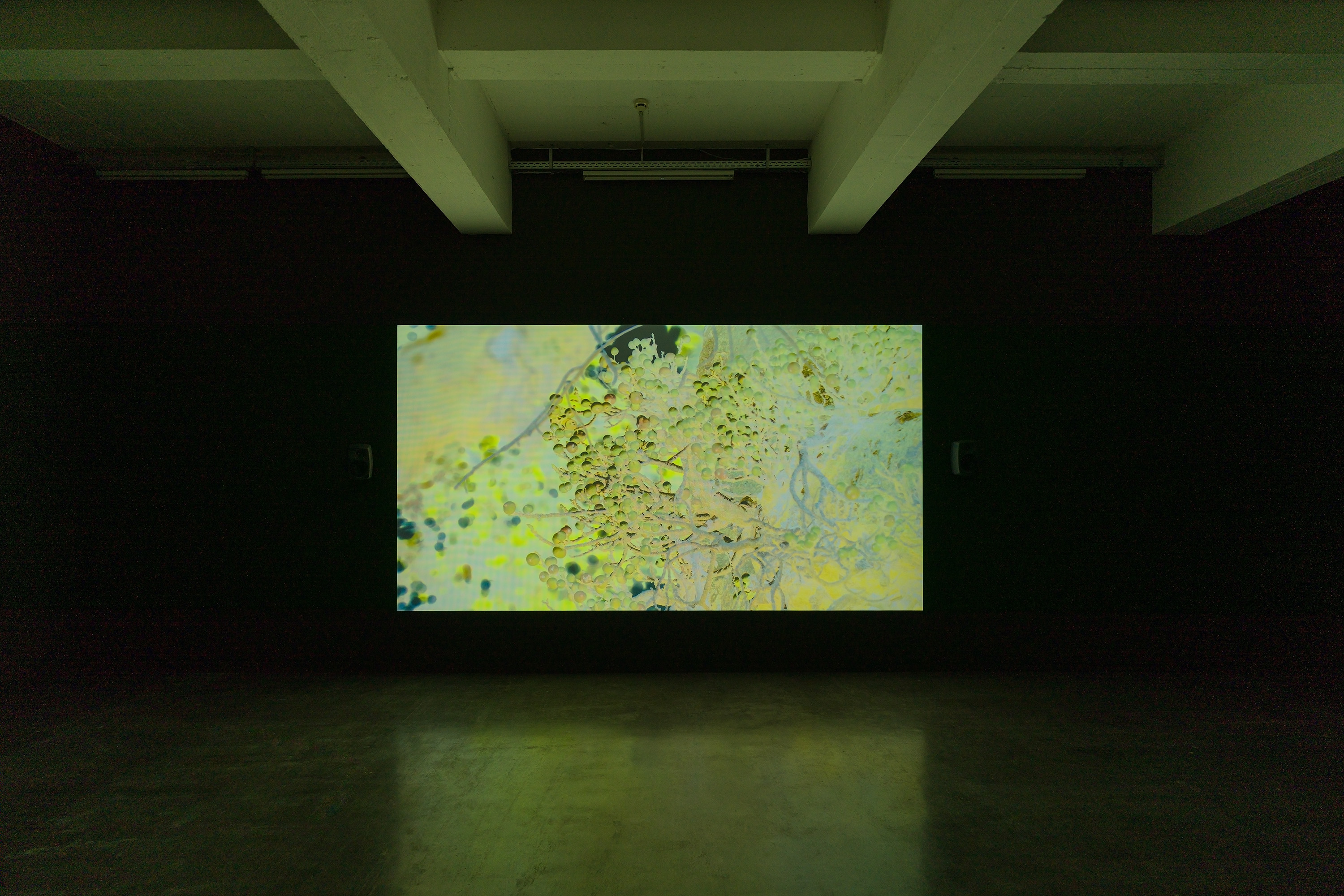
Bianca Baldi expands this perspective to include a temporal dimension. In Hear her calendar system a year of thirteen months, her starting point is a photograph of a fig tree in Ethiopia from her family archive. From this, she progressively grapples with administrative and calendar systems from the colonial eras. Video, sketches and a vocal composition become superimposed on linear and cyclical time models. The tree appears both as a more-than-human witness of historical violence and the embodiment of alternative conceptions of time. History becomes legible here not as a closed chronology but rather as a changeable structure.
Sarah Reva Mohr examines power dynamics in social and physical spaces and in relationship to humans and animals. The work sensational view, tired screams also deals with an institutionally organised space: the Barcelona zoo. In this installation, a multi-layered analysis of the zoo unfolds, a place torn between the promise of care and the exertion of power. Different perspectives reveal the regime of the colonial gaze and the aestheticisation of control. The zoo becomes an apparatus in which sight, knowledge and hierarchy intertwine and power relations within society materialise.
In Jarramplas, Yalda Afsah examines a century-old ritual in Piornal, Spain, in which one of the village’s inhabitants puts on a costume and has carrots thrown at them by the crowd. This film work focuses on the structure of assembly: on the intensity of bodies connected in space, on collective action and the dynamics created when individual gestures become synchronised within a group. By keeping essential elements of what’s happening outside the frame, Afsah shifts the focus away from a folkloristic narrative on to the mechanisms which form community.
With the Alternatives Denkmal für Deutschland, the Alternative Monument collective shifts their engagement with institutionalised memory into the public and digital realm. Their augmented reality project doesn’t possess a permanent physical form, but is activated in each individual situation via mobile devices instead. Visual collages, sculptural elements and sound fragments connect individual narratives of migration, exile and displacement. The monument isn’t erected through materiality or duration here, but rather by collective actualisation. Memory can be experienced as a polyphonic process that resists any final fixed form.
As part of the Talks programme curated by Franziska PIerwoss, a workshop put on with the Alternative Monument collective opens up an “Alternatives Denkmal für Deutschland” as a living platform for exchange and experimentation - and will explore together with the participants how a contemporary monument to migration can be developed in public space despite structural restrictions.
The works that make up An Incomplete Assembly show institutions as choreographies of images, bodies and time structures which direct behaviour and organise belonging. By revealing media blind spots, architectural inscriptions, temporal patterns and memory political emphases, they open up spaces in which order doesn’t appear as a given, but rather as something to be negotiated.
Picture Copyright: Bianca Baldi